_____________________________
What's your favourite book?
I can already see a few of you rolling your eyes but go with me on this one.
Have you got something in mind?
So what's your favourite film?
What about your favourite colour? Or your favourite song?
What about your favourite colour? Or your favourite song?
Maybe these were easy questions to answer or maybe they weren't. Maybe you had some trouble trying to figure out what you liked above all others.
But what if I asked you what your favourite adaptation was?
Suddenly the question becomes a lot harder. After all, adaptations come in many different forms from book to movie, graphic novel to movie or television series, film to stage production, music to stage show or, in a few cases, book to book. That doesn't even include the fact that sometimes these examples can go the other way (such as tie in novelisations, film musicals and even games).
So what exactly do I mean by the term 'adaptation'? According to Oxford dictionaries, there are a number of definitions including 'a film, television drama, or stage play that has been adapted from a written work' but this is somewhat limiting. After all, not every written work is an original work and screenplays or scripts are not the same as a book or novel because of the intended medium. Screenplays are created with the understanding that they will become visual creations. Books do not have such limitations and therefore do not need to be concerned about what is on screen at any given time. However, the word 'adapt' has a much more appropriate definition; 'make (something) suitable for a new use or purpose'. In other words, to recreate a work for a different format or for a different audience.
This isn't nearly as simple as it may seem. After all, every medium has its own set of benefits and limitations that have to be acknowledged and considered. Visual mediums require less description. We don't need to be told that someone is scared because we can see it. But at the same time, it's easier to write the experience of someone flying rather than attempting to create it (budget notwithstanding).
Everyone has their own opinions about good and bad adaptations that have been created over the years and there are many different opinions as to why they exist. One of the most common adaptations that exists, and the one I will be focusing on, is the book to movie adaptation and it is very easy to start comparing the two and declare that 'The book was better'. I am very guilty of doing the same thing and it is only in recent years that I have begun to understand more about how the two mediums work and the difficulties that exist in adapting. In some cases, it is very easy to stick to the original. The Hunger Games and Harry Potter films made a significant effort to stick as close to the original text as possible, with a few necessary tweaks to compensate for difference of medium. However, just sticking to the original text isn't enough and sometimes sticking too close to the original can cause problems of their own. Musicals can often come under scrutiny for this with many fans walking away declaring 'It's the stage show on a bigger budget'. We expect more from a film than we do for a book or a stage show in terms of visuals and soundtrack.
But what about those adaptations that veer wildly off-track and still manage to be good? What is it about them that manage to hit the mark when so many fail?
How to Train Your Dragon is a very popular film with a great story and brilliant visuals, but many people are unaware of the fact that they are based on a series of books by Cressida Cowell…and they do not share many similarities with the film that shares their name. But does that make the film a bad adaptation?
But what if I asked you what your favourite adaptation was?
Suddenly the question becomes a lot harder. After all, adaptations come in many different forms from book to movie, graphic novel to movie or television series, film to stage production, music to stage show or, in a few cases, book to book. That doesn't even include the fact that sometimes these examples can go the other way (such as tie in novelisations, film musicals and even games).
 |
| And sometimes, even toys can get movie adaptations...which are adapted into games and toys. |
So what exactly do I mean by the term 'adaptation'? According to Oxford dictionaries, there are a number of definitions including 'a film, television drama, or stage play that has been adapted from a written work' but this is somewhat limiting. After all, not every written work is an original work and screenplays or scripts are not the same as a book or novel because of the intended medium. Screenplays are created with the understanding that they will become visual creations. Books do not have such limitations and therefore do not need to be concerned about what is on screen at any given time. However, the word 'adapt' has a much more appropriate definition; 'make (something) suitable for a new use or purpose'. In other words, to recreate a work for a different format or for a different audience.
This isn't nearly as simple as it may seem. After all, every medium has its own set of benefits and limitations that have to be acknowledged and considered. Visual mediums require less description. We don't need to be told that someone is scared because we can see it. But at the same time, it's easier to write the experience of someone flying rather than attempting to create it (budget notwithstanding).
'The Book was Better'
Everyone has their own opinions about good and bad adaptations that have been created over the years and there are many different opinions as to why they exist. One of the most common adaptations that exists, and the one I will be focusing on, is the book to movie adaptation and it is very easy to start comparing the two and declare that 'The book was better'. I am very guilty of doing the same thing and it is only in recent years that I have begun to understand more about how the two mediums work and the difficulties that exist in adapting. In some cases, it is very easy to stick to the original. The Hunger Games and Harry Potter films made a significant effort to stick as close to the original text as possible, with a few necessary tweaks to compensate for difference of medium. However, just sticking to the original text isn't enough and sometimes sticking too close to the original can cause problems of their own. Musicals can often come under scrutiny for this with many fans walking away declaring 'It's the stage show on a bigger budget'. We expect more from a film than we do for a book or a stage show in terms of visuals and soundtrack.
But what about those adaptations that veer wildly off-track and still manage to be good? What is it about them that manage to hit the mark when so many fail?
How to Train Your Dragon is a very popular film with a great story and brilliant visuals, but many people are unaware of the fact that they are based on a series of books by Cressida Cowell…and they do not share many similarities with the film that shares their name. But does that make the film a bad adaptation?
 |
| Two different takes... |
 |
| ...on the same material. |
To a certain extent you could argue that it does because it changes the plot of the original story. But, as discussed before, even those that stay relatively faithful to the original texts will make some tweaks to the script in order to correspond with a new medium or current social structure. As a film, it had good characterisation, a coherent and interesting plot and some stunning visuals. It remained aware of its own medium and used it to good effect. As an adaptation, it brought the original book series to the attention of the audience and even influenced the author herself in how she handled the later books in the series.
But not every adaptation comes from a work of fiction. How often have we seen something emblazoned with the words 'Based on real events' or 'Based on a true story'? What about historical events that are adapted for literature or screen? These don't have the same freedom as a work of fiction might because of the web of truth that surrounds it. Academics spend their lives studying and discovering the past and, depending on the story being told, those who lived it might still be around. While some creators would normally get around these issues by keeping historical figures and key events along the sidelines, there are those who prefer to have the big issues remain front and centre of the story. But there is no singular version of history, so how can these events be properly adapted for 'entertainment'?
It is important to understand one major issue; in any work regarding historical events, we will never get the complete story. Like any work of fiction, there will be a certain bias and we will be invited to sympathise with one side at the expense of the other. Some people will be forgotten or relegated to the background and sometimes, the order of events may be at odds with narrative timing and purpose. But what makes, for example, The King’s Speech better than Pearl Harbour in spite of their historical inaccuracies? A lot of it comes right back to the story and the characters. Most of us are not professional historians and we rely solely on the adaptations to explain what happened in the past and the people responsible, or how it affected everyone else. We may not have known George VI or Lionel Logue, but we can sympathise with the difficulties of overcoming a stammer and the pressures of public speaking. The film is about the men and their efforts, not about the outbreak of World War Two around them.
In contrast, the events depicted in Pearl Harbour have no real narrative focus behind them beyond a few fictional individuals being action heroes, which is one of the biggest reasons why it frustrates and angers so many. The actual events of Pearl Harbour are ignored and glossed over in favour of creating an action movie with an historical setting. As a film, it is considered to be poor but as an historical adaptation that makes very little effort to acknowledge the event it is meant to portray, it is considered deplorable.
So what about a combination of the two? After all, not every original work has been created in the last twenty years. Works by Jane Austen, Sir Arthur Conan Doyle, C.S. Lewis or even William Shakespeare have been adapted and re-adapted over and over again for the stage, the screen and even condensed for children. So what do you do when someone takes an older work and creates a modern version of it, placing older stories in a modern context as Steven Moffat and Mark Gatiss did to create Sherlock?
Modern adaptations are very difficult to create because it isn't possible to just create a straight adaptation. It's not enough to have Romeo and Juliet just wandering around with mobile phones and the Internet and declare the adaptation modern. Other things such as social expectations, technology and even setting have to be taken into consideration. While Baz Luhrman didn't change the language of his Romeo and Juliet, he changed the setting and created modern versions of important elements to create the juxtaposition he wanted. Guns instead of swords, cars rather than horses and a Chief of Police instead of a royal prince.
One of the biggest issues that a modern adaptation has to take into consideration is the difference in social expectation between the creation of the original work and today. So, for example, in Pride and Prejudice, there is a great deal of focus on getting the Bennet sisters married off, something that would not be considered acceptable for many people in a contemporary setting. Some adaptations do make an effort to adapt the circumstances to reflect the changing times. So in Bridget Jones’ Diary it is Bridget who is searching for a boyfriend, and in Bride and Prejudice, Lalita Bakshi's mother is part of an older generation from India that sees marriage as an important way of securing a woman's future. But in both cases, the centrality of 'needing a man' is still present and can be quite off-putting, especially in a world where women are still struggling to be acknowledged as men's equals.
The Lizzie Bennet Diaries, a web series by Hank Green and Bernie Su, changes this central concept completely while still maintaining the central themes of the book. Instead of the focus being on marriage (apart from Mrs Bennet's hopes…at least according to Lizzie), the focus is on the girls' careers. In the original story, the need to marry off the girls was a necessary step to secure their futures. After all, a woman rarely had a steady income apart from a one-off dowry payment. Nowadays, women have more opportunities and are less dependent on men to secure their futures. So in The Lizzie Bennet Diaries, while the elements change, the overall themes and intents remain the same.
But what if those elements were changed on a much greater scale?
Sherlock Holmes has been adapted again and again and most recently, has been taken out of his historical setting of Victorian England and placed in 21st century London and New York in Sherlock and Elementary respectively. The former created a great deal of hype when it arrived because it was the first time this historical character had been taken out of his habitat in this way (I am not including Sherlock Holmes in the 22nd century here for obvious reasons). It was clever, it was slick and it made an effort to provide a modern twist to the old stories. But Elementary made waves for another major reason; the casting of Lucy Liu as Joan Watson.
This was a big deal. Holmes and Watson are one of the biggest bromances in literary history. Their friendship is deep, caring and utterly fascinating (not to mention the subject of much slash fiction but that is quite common). So by casting a woman, there were huge fears among Sherlock Holmes fans that this was a ploy to create sexual tension for the show and a way to get the two main characters together in a way that would not cause problems for conservative watchers. Fortunately (so far), the show has kept the bromance as it was and even made an effort to put the two characters on an equal footing. Joan is not a potential love interest or sidekick, she is a partner who Holmes is teaching his methods to, can contribute to cases and even solve some on her own. This was as far away from the original portrayal of the bumbling sidekick as you could get although opinions do differ as to whether these changes enrich or weaken the connection with the source material.
It is very hard to pinpoint what makes a good adaptation but one of the major things that needs to be taken into consideration is the change in medium and what alterations need to be made in order to tell a coherent story using that medium. An adaptation does not have to be completely faithful to an original source because it never can be. Times change. Society moves on. And interpretations alter. The original creator is rarely involved in an adaptation (although they might be consulted a few times during the process) and the original audience may not be the ones who are being targeted for the new product. Those who read the book may not necessarily be the ones who watch the film, the ones who will play the game or the ones who understand the history. They might know everything about the original story that is playing out before them but they might not. It is essential that an adaptation is able to stand on its own, no matter what form it takes. That does not mean spoon-feeding or holding the audience by the hand, but it does mean carefully considering the source material and using that to create an interesting and dynamic story with engaging characters. After all, the story you tell will be the first introduction to that world for somebody. Make sure it's a good one.
Rewriting History
But not every adaptation comes from a work of fiction. How often have we seen something emblazoned with the words 'Based on real events' or 'Based on a true story'? What about historical events that are adapted for literature or screen? These don't have the same freedom as a work of fiction might because of the web of truth that surrounds it. Academics spend their lives studying and discovering the past and, depending on the story being told, those who lived it might still be around. While some creators would normally get around these issues by keeping historical figures and key events along the sidelines, there are those who prefer to have the big issues remain front and centre of the story. But there is no singular version of history, so how can these events be properly adapted for 'entertainment'?
It is important to understand one major issue; in any work regarding historical events, we will never get the complete story. Like any work of fiction, there will be a certain bias and we will be invited to sympathise with one side at the expense of the other. Some people will be forgotten or relegated to the background and sometimes, the order of events may be at odds with narrative timing and purpose. But what makes, for example, The King’s Speech better than Pearl Harbour in spite of their historical inaccuracies? A lot of it comes right back to the story and the characters. Most of us are not professional historians and we rely solely on the adaptations to explain what happened in the past and the people responsible, or how it affected everyone else. We may not have known George VI or Lionel Logue, but we can sympathise with the difficulties of overcoming a stammer and the pressures of public speaking. The film is about the men and their efforts, not about the outbreak of World War Two around them.
 |
| A friendship that would last a lifetime begins with a few simple words. |
In contrast, the events depicted in Pearl Harbour have no real narrative focus behind them beyond a few fictional individuals being action heroes, which is one of the biggest reasons why it frustrates and angers so many. The actual events of Pearl Harbour are ignored and glossed over in favour of creating an action movie with an historical setting. As a film, it is considered to be poor but as an historical adaptation that makes very little effort to acknowledge the event it is meant to portray, it is considered deplorable.
So what about a combination of the two? After all, not every original work has been created in the last twenty years. Works by Jane Austen, Sir Arthur Conan Doyle, C.S. Lewis or even William Shakespeare have been adapted and re-adapted over and over again for the stage, the screen and even condensed for children. So what do you do when someone takes an older work and creates a modern version of it, placing older stories in a modern context as Steven Moffat and Mark Gatiss did to create Sherlock?
'Past, have you met Present?'
Modern adaptations are very difficult to create because it isn't possible to just create a straight adaptation. It's not enough to have Romeo and Juliet just wandering around with mobile phones and the Internet and declare the adaptation modern. Other things such as social expectations, technology and even setting have to be taken into consideration. While Baz Luhrman didn't change the language of his Romeo and Juliet, he changed the setting and created modern versions of important elements to create the juxtaposition he wanted. Guns instead of swords, cars rather than horses and a Chief of Police instead of a royal prince.
One of the biggest issues that a modern adaptation has to take into consideration is the difference in social expectation between the creation of the original work and today. So, for example, in Pride and Prejudice, there is a great deal of focus on getting the Bennet sisters married off, something that would not be considered acceptable for many people in a contemporary setting. Some adaptations do make an effort to adapt the circumstances to reflect the changing times. So in Bridget Jones’ Diary it is Bridget who is searching for a boyfriend, and in Bride and Prejudice, Lalita Bakshi's mother is part of an older generation from India that sees marriage as an important way of securing a woman's future. But in both cases, the centrality of 'needing a man' is still present and can be quite off-putting, especially in a world where women are still struggling to be acknowledged as men's equals.
The Lizzie Bennet Diaries, a web series by Hank Green and Bernie Su, changes this central concept completely while still maintaining the central themes of the book. Instead of the focus being on marriage (apart from Mrs Bennet's hopes…at least according to Lizzie), the focus is on the girls' careers. In the original story, the need to marry off the girls was a necessary step to secure their futures. After all, a woman rarely had a steady income apart from a one-off dowry payment. Nowadays, women have more opportunities and are less dependent on men to secure their futures. So in The Lizzie Bennet Diaries, while the elements change, the overall themes and intents remain the same.
But what if those elements were changed on a much greater scale?
Sherlock Holmes has been adapted again and again and most recently, has been taken out of his historical setting of Victorian England and placed in 21st century London and New York in Sherlock and Elementary respectively. The former created a great deal of hype when it arrived because it was the first time this historical character had been taken out of his habitat in this way (I am not including Sherlock Holmes in the 22nd century here for obvious reasons). It was clever, it was slick and it made an effort to provide a modern twist to the old stories. But Elementary made waves for another major reason; the casting of Lucy Liu as Joan Watson.
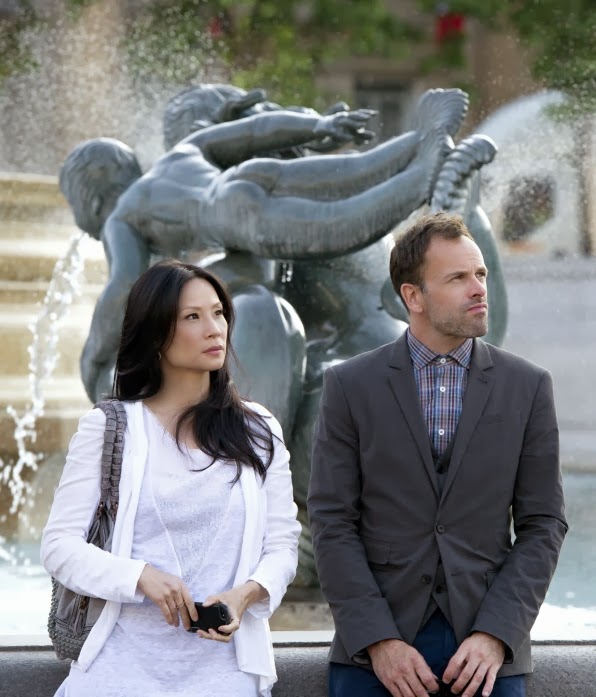 |
| A partnership for the ages with a few little tweaks |
This was a big deal. Holmes and Watson are one of the biggest bromances in literary history. Their friendship is deep, caring and utterly fascinating (not to mention the subject of much slash fiction but that is quite common). So by casting a woman, there were huge fears among Sherlock Holmes fans that this was a ploy to create sexual tension for the show and a way to get the two main characters together in a way that would not cause problems for conservative watchers. Fortunately (so far), the show has kept the bromance as it was and even made an effort to put the two characters on an equal footing. Joan is not a potential love interest or sidekick, she is a partner who Holmes is teaching his methods to, can contribute to cases and even solve some on her own. This was as far away from the original portrayal of the bumbling sidekick as you could get although opinions do differ as to whether these changes enrich or weaken the connection with the source material.
Conclusion
It is very hard to pinpoint what makes a good adaptation but one of the major things that needs to be taken into consideration is the change in medium and what alterations need to be made in order to tell a coherent story using that medium. An adaptation does not have to be completely faithful to an original source because it never can be. Times change. Society moves on. And interpretations alter. The original creator is rarely involved in an adaptation (although they might be consulted a few times during the process) and the original audience may not be the ones who are being targeted for the new product. Those who read the book may not necessarily be the ones who watch the film, the ones who will play the game or the ones who understand the history. They might know everything about the original story that is playing out before them but they might not. It is essential that an adaptation is able to stand on its own, no matter what form it takes. That does not mean spoon-feeding or holding the audience by the hand, but it does mean carefully considering the source material and using that to create an interesting and dynamic story with engaging characters. After all, the story you tell will be the first introduction to that world for somebody. Make sure it's a good one.


